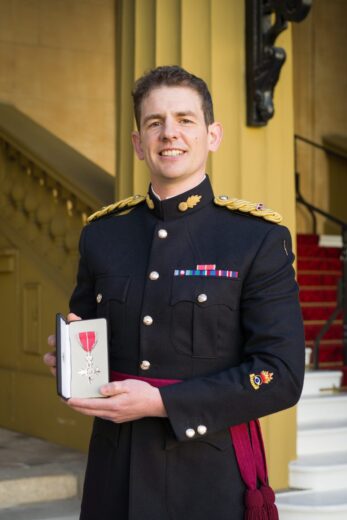
Major Josh Wray, Royal Engineers (S.J.S. 2002-04, Hart 2004-07) was appointed as a member of the Military Division of the Most Excellent Order of the British Empire (MBE) in the New Years Honours List 2025. He was presented his award by the Princess Royal at Buckingham Palace in March this year. Josh commissioned into the Royal Engineers, having studied Civil Engineering at Birmingham University. He has had a diverse career to date including multiple deployments across the globe, spanning tactical command to strategic planning. Josh is married with two children. As a family they love the outdoors and, when time allows, Josh can be found seeking out the next challenging ridge-line .
To celebrate the School’s quincentenary the Development Office has released some Wilson Run limited edition commemorative running T-shirts.
The T shirts are navy blue with gold lettering.
If you would like to purchase one of these T-shirts please contact María Gallego-Calderón at mgal@sedberghschool.org
The price is £25, plus £5 for postage.
Harry Brook (W 13-17) will take over as captain of England’s T20 and ODI teams after Jos Buttler stepped down from his post in the wake of a disappointing group-stage exit in the Champions Trophy.
The 26-year-old Brook begins his tenure with a home series against West Indies at the end of May, having experienced a taste of the captaincy in the absence of the injured Buttler during last September’s ODI series against Australia.
Read more HERE.In the run up to International Women’s Day, School Archivist Katy de la Rivière had the opportunity to speak to Abbie Ward (née Scott), Robertson 2009-11, about her experiences in Sedbergh and her career as a Rugby Union player.
What provision was there for girls’ sport when you were here at Sedbergh as a pupil?
There was amazing provision for sport, and that’s one of the main things that attracted me to Sedbergh in the first place. The quality of the coaches and the sporting ethos were amazing. Girls didn’t play rugby during my time here but the programmes for girls’ hockey, girls’ netball, the tennis and the lacrosse were all very successful. Although there wasn’t girls’ rugby at Sedbergh, they really supported me in my pursuit of rugby. I was on the divisional County pathway for the under-20’s girls’ rugby and had my own programme to follow and Sedbergh staff really helped me with that. During odd sessions they’d let me join in with the boys, and for my personal strength and conditioning programme which I would have to do in the gym I was given lots of support.
When did you start playing rugby?
My first taste of rugby was playing touch rugby at my local rugby club in Keswick as a child. The rugby club was a centre point of the community and I really wanted to be involved. I’d have been around ten when I first played during summer holidays. Then around 14 I started playing more but there wasn’t much rugby for girls, just a few tournaments a year. When I went to university I started playing more, for the University mid-week and for DMP Sharks at the weekends.
I already played hockey, football, netball, tennis, athletics, everything. Rugby was just another sport to get involved with. But what I really enjoyed about rugby is how it’s so multifaceted. There’s not just one aspect of the game that you have to try and learn and master. There’s passing, tackling, set-pieces, kicking, the breakdown. I really enjoy that there is so much to learn and so much to try and master in rugby.
The move towards women’s players becoming professional has happened during your career. How has that changed the game?
100%. Contracts were introduced for a nine-month period, in the run-up to the 2017 World Cup. Then they were pulled, and then reintroduced in 2019. So it’s only been professional since 2019, with, obviously, the little stint in 2017.
Seeing that transition from amateurism to professionalism, it’s been huge. It’s been huge in terms of allowing the players to shine, allowing the players to focus. Their focus is only on performance so the game has been able to just skyrocket. When you invest in the players, you see better performances on pitch. Then you see an increase in spectators, in investment, in funding. And then it’s just like a continuous circle. From where I was, where I was paying for my own kit, I was paying to play. I was paying for food after games to where it is now. It’s night and day difference. It’s been an incredible journey. And, you know, I’m very lucky to have been involved in that, been involved as one of those players that’s also been fighting for those changes and contracts. And although I won’t see the pinnacle of professional rugby, I’m excited to see where it goes for the players that come along in the future.
Ilona Maher has joined the Bristol Bears in the last few months, with her Instagram following of nearly 5 million. How do you think social media or the presence of social media helps to promote the game?
It’s huge. The thing that I love about rugby is one to 15 – everyone has got a very different job. Everyone has to have a very different set of skills in rugby. There’s a place for everyone. And I think that’s the same with personality. Social media puts a spotlight on individuals to show, yes, we all are a team, but within that team, it’s really important that we highlight and showcase individuals.
Female rugby players must be some of the strongest women athletes around. Over the course of your career, do you think there has been a change in how femininity is defined and how strong women are celebrated?
Absolutely. There is a huge trend towards celebrating strong women. And it’s here to stay. We can acknowledge that women can be strong and, can have big personalities, and can be celebrated. Rugby is such a great sport for illustrating and highlighting that and the individuals that portray those traits. Social media has played a great role in knocking down or questioning stereotypes. And I think that has been really healthy. As a sport, there a place for absolutely everybody in rugby. That’s been key.
The trend towards actually being healthy, being fit, being strong have made these things fashionable. It’s great that young girls can look at that and can aspire to be that.
You’ve had a family and continued to play at a high level. Did you feel that you were well supported during your pregnancy, and in returning to training and playing after you had your daughter?
Yes, I was really well support. The club’s maternity policy had only just been put together. It had been in the process of being written for a couple of years, but it came to fruition with near perfect timing for when I had Hallie. I was incredibly supported where I did all my training, which was at Bristol Bears. The coaches, the strength and conditioning staff, the medical staff all went above and beyond in terms of research and making sure that they were able to accommodate me to continue to train and keep pushing myself. Because that’s what I wanted to do. They would have also been more than happy supporting me if I wanted to take a complete step back and just enjoy that time away from rugby. But I made it well known from the start that I wanted to continue training, pushing myself as much as I could throughout pregnancy with the aim of returning to the pitch as soon as possible. They worked with me to achieve that. Likewise, at England, you know, they worked in tandem with Bristol Bears to help me achieve that and to return on the international stage. I was able to bring Hallie into Six Nations and into training camps which was amazing. I want that to become the norm, athletes being able to be mothers and professional athletes at the same time.
My daughter was 17 weeks old when I played my first matches. She ran out with me at Ashton Gate, which was pretty special, that was for the opening game of the Premiership that year. Now that she’s a bit older it just gets more special because she’s got a bond with my teammates and she’ll come into the changing rooms after matches, running around and collecting all sorts of water bottles and balls and cones. She really is part of the team and it’s incredible to share those moments with her.
What do you think Sedbergh gives to its pupils in terms of creating mindsets or giving pupils skills that they can take forward?
It instilled a really solid work ethic. But with the ethos of work hard, play hard. Work really hard, but when you get time to relax or to celebrate or be with your friends, enjoy those moments. For me, that’s really important as a professional athlete because it can be so intense. When you’re in Six Nations, when you’re in World Cup camp, it can be really intense and it’s important to find that switch off in your downtime. I definitely learned that at Sedbergh.
There was a family ethos at school. I’ve literally just got back from a weekend away with the Sedbergh girls, and their partners and their kids. 14 years later. Those are friendships for life, really. It’s about how you keep showing up for each other. I was only at Sedbergh for two years. But 14 years on, we’re still showing up for each other. That’s incredibly special as well.The OS community is warmly invited to watch the Sedbergh Sevens teams compete at the Rosslyn Park National Schools Sevens Tournament.
The tournament will be taking place the week commencing the 24th March.
Please find the schedule for the tournament via the link here: Tournament Schedule 2025 – Rosslyn Park National Schools 7s
There will be a Sedbergh hospitality tent next to the RE 1 pitch this year where all members of the Sedbergh community are warmly invited to pop in and have some refreshments.
We look forward to seeing you there!Dugald Bruce-Lockhart (SH 81-86) is currently starring in ‘Witness For The Prosecution’ at London County Hall. Read more about the production HERE.
Dugald is a writer, actor and director. He trained at RADA and has worked extensively with UK theatre companies including the RSC, The National Theatre, The English Touring Theatre, Bath Theatre Royal, Hampstead Theatre and The Old Vic. As a long-standing member of Edward Hall’s internationally-acclaimed Propeller, he played roles including Henry V, Petruchio, and Olivia, before becoming an associate director. He toured the UK as Hannay in The 39 Steps; and West End appearances include Freddie in The Deep Blue Sea, Lysander in Propeller’s Midsummer Night’s Dream, Bill Austin in Mamma Mia, and recently, Victor Prynne, in Private Lives. He received a Best Actor nomination from The Stage for his portrayal of David Cameron in William Gaminara’s The Three Lions, and a Critics Award for Theatre in Scotland Best Actor nomination for his role as Mephistopheles in Faust at the Edinburgh Lyceum. TV and film work includes The Castaways, Call the Midwife, The Crown, Professor T, From Time to Time, Hart’s War, Alive and Kicking, Deserter, Case Histories, Foyle’s War, Midsomer Murders, Trust, and Hotel Babylon. He narrated a landmark documentary series for the Smithsonian Channel, Aerial Britain, which launched in the UK in 2019. His debut novel, The Lizard – a suspense thriller set in the Greek islands in 1988 – was published in 2020 and his second novel, Second Skin was published in May 2024.
Visit Dugald’s website HERE.Alex (R 15-20) is taking part in ‘Ride of the Their Lives 2025’ on 14th June to raise money for Macmillan Cancer Support. Full details of the event and how you can support are in the flyer below. We wish Alex lots of luck!
Sedbergh’s rich archive collection is the result of generous donations over many generations. It is a great privilege to have so many primary source documents to bring Sedbergh’s past to life. Amongst this collection are eleven boxes of ‘magic lantern slides’, glass positive slides from the 19th century and early 20th century which offer rare insight into life at School up to 150 years ago.
In Spring 2025 the Development Office purchased a new high resolution archive scanner and transparency unit to help bring the collection of photographs and glass slides to life in Sedbergh’s 500th year. Over the course of Sedbergh’s quincentenary year this special collection of images will be digitised and shared, offering a unique view to our past.
As the images are captured between two pieces of glass, held together by tape, it is not possible to capture the picture using a conventional scanner. The new transparency unit allows us to capture the image without causing blurring as the light refracts through the glass.
It is most exciting to have the opportunity to scan and share these images, some over 150 years old. The images include early Wilson Run races, scenes in boarding houses, portraits of staff and views of the School site. The informal nature of the scenes make the images most engaging, and very different to most of the posed shots in the collection from that time.
We look forward to sharing the collection of magic lantern slides as they are scanned.
Katy de la RivièreSchool Archivist This year the OS Club will be live streaming the Wilson Run from the fells, as well as at the start and finish. We invite you to join us from 1.30pm GMT on Tuesday 25th March 2025 for the pre-show using the link below. The race will start at 2.30pm.
Wilson Run 2025 | Live Stream
Coverage includes pre-race interviews with record holders, runners, and the School Archivist. The race will follow the runners around the course with commentary by Ben Collins (Associate Director of Development and Wilson Run winner) and Jan van der Velde (Director of Development).
The weather is wet, the rivers are swollen, the fells boggy under foot. Never was ‘strain and struggle, might and main’ so apt. It all makes for an exciting day. Do join us at 1.30pm on Tuesday 25th March.
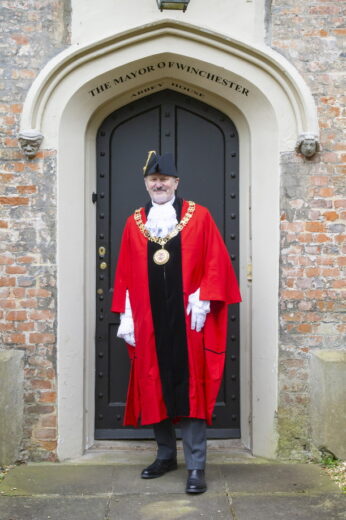
We look forward to you joining us over the Wilson Run period!There has been a mayor of Winchester since 1199, the year that Richard, Coeur de Lion, died and his brother, King John, succeeded to the throne of England. The city is proud to say that the mayoralty of Winchester is second only to London in seniority. Over the centuries the power of the mayor has changed from being the leader of an influential oligarchy to being rather more a figurehead representing the City of Winchester and the district which covers 250 square miles.
Whilst the mayor no longer has executive powers, he or she has a number of important statutory duties: leading civic events, granting freedom of the city, wreath-laying, chairing the monthly meeting of the full council. There are some light-hearted occasions too: the annual Shrove Tuesday pancake race held in the Cathedral close and leading the procession to the November 5th bonfire night display and setting off the fireworks.An important element of the role is recognising the work of charities and encouraging volunteer efforts, particularly those of smaller and lesser known specialist local charities that do such sterling work. As I spend a lot of my time visiting local businesses and charities, I can foster and encourage useful links between them.Every mayor each year selects three or four local charities to promote. I have chosen four. Fundraising is time consuming and by no means easy in our present financial climate. I have been immensely grateful to all the volunteers who have worked so hard with me to raise money for the chosen charities. I have brought in some innovative ideas such as special mayoral merchandise to sell at a range of money-raising events throughout the year.
A sound economy is essential to the district, and I am always keen to support new businesses that open up or expand in the area. Recently I went to an event to celebrate the expansion of the Saab Business Campus. I have opened many new shops, cafes, restaurants and even a funeral service. I had to think hard about what to say in my speech wishing their business success.
By tradition, the mayor, during the year of office, becomes a trustee of various organisations. One of my favourites is the Hospital of St Cross, the most ancient alms-houses in the country. ‘The Brothers of Noble Poverty’ are a lovely group, and amongst them is David Kilmister, an Old Sedbergian, (Hart), who recognised my OS tie which I happened to be wearing when I first visited. The mayoralty also has strong connections with the Cathedral and its ancient Christian traditions. We hold an annual Mayors’ Sunday in which the Mayor of Winchester sets the theme for the service.
I have learned so much during my time as mayor: many aspects of our ancient city and the wonderful people who live within and throughout the district. I have found that one sees the very best side of citizens, and people really appreciate a visit by the mayor, particularly when he or she turns up wearing the wonderful gold chain and full regalia. My best memory of this is of my visit to a special needs school. The Head had asked that I come in ‘full fig’ as the children love to see it. One little boy stopped in his tracks and said, ‘Are you the King?’ It made my day.
Russell Gordon-Smith
Read a Winchester City Council article about Russell HERE.





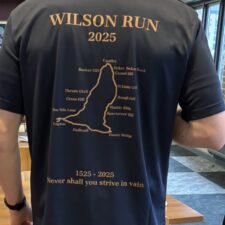
 To celebrate the School’s quincentenary the Development Office has released some Wilson Run limited edition commemorative running T-shirts.
The T shirts are navy blue with gold lettering.
If you would like to purchase one of these T-shirts please contact María Gallego-Calderón at mgal@sedberghschool.org
The price is £25, plus £5 for postage.

 Dugald is a writer, actor and director. He trained at RADA and has worked extensively with UK theatre companies including the RSC, The National Theatre, The English Touring Theatre, Bath Theatre Royal, Hampstead Theatre and The Old Vic.
As a long-standing member of Edward Hall’s internationally-acclaimed Propeller, he played roles including Henry V, Petruchio, and Olivia, before becoming an associate director. He toured the UK as Hannay in The 39 Steps; and West End appearances include Freddie in The Deep Blue Sea, Lysander in Propeller’s Midsummer Night’s Dream, Bill Austin in Mamma Mia, and recently, Victor Prynne, in Private Lives. He received a Best Actor nomination from The Stage for his portrayal of David Cameron in William Gaminara’s The Three Lions, and a Critics Award for Theatre in Scotland Best Actor nomination for his role as Mephistopheles in Faust at the Edinburgh Lyceum.
TV and film work includes The Castaways, Call the Midwife, The Crown, Professor T, From Time to Time, Hart’s War, Alive and Kicking, Deserter, Case Histories, Foyle’s War, Midsomer Murders, Trust, and Hotel Babylon.
He narrated a landmark documentary series for the Smithsonian Channel, Aerial Britain, which launched in the UK in 2019.
His debut novel, The Lizard – a suspense thriller set in the Greek islands in 1988 – was published in 2020 and his second novel, Second Skin was published in May 2024.
Visit Dugald’s website HERE.Alex (R 15-20) is taking part in ‘Ride of the Their Lives 2025’ on 14th June to raise money for Macmillan Cancer Support. Full details of the event and how you can support are in the flyer below. We wish Alex lots of luck!
 Sedbergh’s rich archive collection is the result of generous donations over many generations. It is a great privilege to have so many primary source documents to bring Sedbergh’s past to life. Amongst this collection are eleven boxes of ‘magic lantern slides’, glass positive slides from the 19th century and early 20th century which offer rare insight into life at School up to 150 years ago.
In Spring 2025 the Development Office purchased a new high resolution archive scanner and transparency unit to help bring the collection of photographs and glass slides to life in Sedbergh’s 500th year. Over the course of Sedbergh’s quincentenary year this special collection of images will be digitised and shared, offering a unique view to our past.
As the images are captured between two pieces of glass, held together by tape, it is not possible to capture the picture using a conventional scanner. The new transparency unit allows us to capture the image without causing blurring as the light refracts through the glass.
It is most exciting to have the opportunity to scan and share these images, some over 150 years old. The images include early Wilson Run races, scenes in boarding houses, portraits of staff and views of the School site. The informal nature of the scenes make the images most engaging, and very different to most of the posed shots in the collection from that time.
We look forward to sharing the collection of magic lantern slides as they are scanned.
Katy de la Rivière
School Archivist This year the OS Club will be live streaming the Wilson Run from the fells, as well as at the start and finish. We invite you to join us from 1.30pm GMT on Tuesday 25th March 2025 for the pre-show using the link below. The race will start at 2.30pm.
Wilson Run 2025 | Live Stream
Coverage includes pre-race interviews with record holders, runners, and the School Archivist. The race will follow the runners around the course with commentary by Ben Collins (Associate Director of Development and Wilson Run winner) and Jan van der Velde (Director of Development).
The weather is wet, the rivers are swollen, the fells boggy under foot. Never was ‘strain and struggle, might and main’ so apt. It all makes for an exciting day. Do join us at 1.30pm on Tuesday 25th March.
We look forward to you joining us over the Wilson Run period!There has been a mayor of Winchester since 1199, the year that Richard, Coeur de Lion, died and his brother, King John, succeeded to the throne of England. The city is proud to say that the mayoralty of Winchester is second only to London in seniority. Over the centuries the power of the mayor has changed from being the leader of an influential oligarchy to being rather more a figurehead representing the City of Winchester and the district which covers 250 square miles.