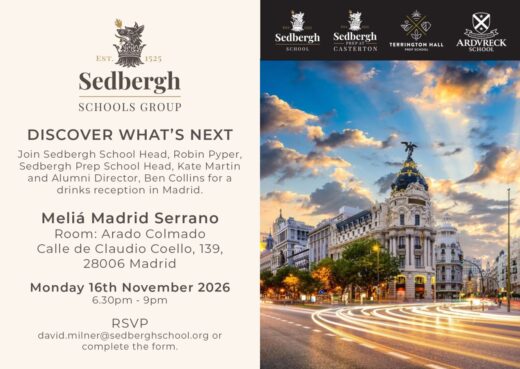
We are delighted to invite our Sedbergh community, friends and partners to a special Sedbergh Schools Group Drinks Reception in Madrid on Monday 16 November.
Join Robin Pyper, Head of Sedbergh School, Kate Martin, Head of Casterton, Sedbergh Preparatory School, and Ben Collins, Director of Development and Alumni, for an evening of celebration, conversation and networking.
As Sedbergh Schools Group continues to grow, we look forward to sharing our latest news, exciting developments and the expanding opportunities available across our schools.Whether youre an Old Sedberghian, current or former parent, prospective family, educational agent or friend of Sedbergh, wed love to see you!
📅 Monday 16 November 2026
🕡 6.30pm – 9.00pm
📍 Meliá Madrid Serrano, Madrid
Partners, colleagues and guests are very welcome. Please do share this invitation with anyone who may wish to join us.
Register your attendance here: https://lnkd.in/ebK2b9Pw
We look forward to bringing the Sedbergh community together in Madrid!
We are pleased to share with you the first two issues of the Sedbergh Vietnam Magazine:
Issue 1: https://heyzine.com/flip-book/413e0f1773.html
Issue 2: https://heyzine.com/flip-book/c0034b3f3c.html
The magazine was created to capture and celebrate the life of our school community — the learning, achievements, activities, people and experiences that are shaping Sedbergh Vietnam as we continue to grow.
We also hope it provides you with a closer window into how the Sedbergh identity is developing in Vietnam, while reflecting the character and context of their own community.
We hope you enjoy reading them.
When Ellie Witt (Lupton, 2003–2008) arrived at Sedbergh School as part of the first cohorts of girls, she could hardly have imagined that she would one day style Hollywood stars, work with international brands and travel the world with six suitcases in tow, building a freelance fashion career along the way. Yet she believes the foundations of her life – confidence, close friendships and a willingness to embrace opportunity – were laid during those early years at School.
“It just felt normal”: Being in the first cohort of girls
Ellie was among the first girls to join Sedbergh following its move to co-education in 2001. Looking back, she remembers a close-knit group who integrated quickly.
“I never really felt like it was a boys’ school and we were just girls in it. It felt pretty equal in that respect, like a normal mixed school. We just were a bit outnumbered!”
If anything, being in the minority strengthened the bonds between the girls. “You’re all the same age, going through exactly the same things, going to exactly the same classes and sports matches, and you just make sisters. They’re like family.”
Those friendships have endured well beyond their schooldays. Today, Ellie and her Sedbergh friends are one another’s bridesmaids and godparents, supporting each other through life’s twists and turns.
“You may be different when you get older and travel your different paths, but there’s a deep bond there. They know you from when you were a child, and it’s really special.”
The confidence to do anything
For Ellie, Sedbergh was a nurturing environment that valued people as individuals, giving them the freedom to be themselves.
“You were free to be who you wanted to be. There wasn’t really any conformity. You were just who you were, and that was it. No judgement, which was pretty rare, I think.”
That freedom helped Ellie develop a confidence she would carry into her working life. “I feel pretty comfortable meeting new people and being myself. It doesn’t faze me going into a situation where I don’t know anyone. If I turn up to work and I’m on set with people I’ve never met before, it doesn’t bother me. I would definitely attribute that to my school experience.”
Ellie left School without a clear idea of what she wanted to do for a living, but with the confidence to believe she could do anything.
“I had the confidence that anything was possible. I really think that came from school. We never felt restricted or inhibited by anything, and I think that’s a real gift.”
That belief would prove valuable as she navigated an unconventional route into fashion, learning on the job and gradually building a career in a notoriously competitive industry.
From Liverpool lecture halls to a fashion epiphany
After leaving Sedbergh, Ellie travelled for a summer before heading to the University of Liverpool, where she studied a combined honours degree in philosophy, psychology and media studies, choosing subjects that interested her rather than following a fixed career plan.
Initially, she thought journalism was the answer, but internships at fashion magazines led to long days on features desks, writing about subjects that didn’t quite ignite her imagination.
Then, during a temporary position with The Telegraph’s magazine team, Ellie found herself helping with photo shoots and attending Fashion Week. One shoot changed everything.
“I went to a shoot one day with one of the editors and was her assistant on set. We were doing a photo shoot for their next issue with, I think it was Luke Evans, an actor, and I just fell in love with it.”
“I’ve never had any other moments like that in my life before, where I just thought: this is it. I love this, and this is what I want to do.”
Drawn to styling, Ellie landed a three-month internship at HUNGER Magazine, opening the door to a new world. Founded by British photographer Rankin in 2011, the quarterly fashion, culture and arts magazine is known for its bold visual style and celebration of emerging talent. For Ellie, it was an opportunity to learn in a creative environment at the heart of the fashion industry.
“That was really the pivotal moment in my whole career. Rankin took a real chance on me. I worked for the magazine on a freelance basis for 10 years, and I still contribute today. It was an amazing experience, and I learned so much. That was how I got into fashion and became a stylist.”
That short internship became a defining chapter in Ellie’s career. Looking back, she sees a connection with Sedbergh: the confidence to explore, try something new and see where it leads.
“I took every opportunity I could, and that internship, I never really thought anything would come of it. But I was there for three months, and after that, that was my way into the industry, and it changed my life. So you just never know what opportunity is going to do that, and I think that’s why I’ve always just said yes to every opportunity, because you just never know.”
The substance of styling
“Being a stylist is essentially dressing people,” Ellie explains. Her work spans advertising campaigns, brand shoots, celebrity portraits, red carpets, parties and award ceremonies.
But the work begins long before anyone steps in front of a camera. Stylists liaise with clients, creative teams and press representatives, develop mood boards, research ideas and agree on the look they want to create. They organise fittings, check sizes and manage last-minute changes before a shoot even begins.
For Ellie, one of the most rewarding aspects of the job is that it is as much about people as clothes. What someone wears can be deeply personal, and even those who appear confident may feel vulnerable when it comes to their image. Building trust is essential.
“People are very conscious about their clothing… It’s a real privilege to be able to dress people and to have them trust you to put them in something they may not have chosen themselves… you get to instil them with confidence.”
“You start to understand how people work and what their vibe is, and judging their energy.”
For Ellie, understanding people is central to the job. She has learnt not to make assumptions. Even someone who appears entirely comfortable in themselves can feel exposed when another person is making decisions about their appearance.
“It’s a very personal job. I go to people’s homes, meet their families, meet their teams who they work with. And, equally, with advertising clients, you work so closely with them for a long time. You establish relationships.”
Ellie is quick to dispel any suggestion that styling is all glamour.
“Most of our time is spent with suitcases – unpacking them, packing them, carrying them up and down flights of stairs, steaming non-stop, going to all the different stores to do returns, going to the post office with a car full of boxes.”
“It’s not an easy job, and physically it’s quite hard. You’re on your feet all day… lugging clothes and suitcases all over the place. But it’s worth it.”
“Seeing a front cover of a magazine that’s your image that you’ve styled… those moments are really special. I’ll walk past sometimes magazine shops, and there’ll be a front cover that I did, and it’ll be a real pinch-me moment.”
Ultimately, the reward lies in helping someone look and feel like the best version of themselves.
A career without borders
Over the years, Ellie’s work has taken her well beyond London. She has worked with brands including Nike, Adidas, Diet Coke, Four Seasons, Hilton, Aston Martin, Rolls-Royce, Cartier and De Beers, alongside haircare and skincare brands.
International shoots have taken her to Cape Town, Rio de Janeiro, Costa Rica, Hawaii and Mexico. Ellie relished the adventure.
“I was flying around the world to dress people, and I just couldn’t believe that this was my life. Travelling with six suitcases across the world on your own definitely makes you very comfortable with international travel.”
There have been extraordinary moments along the way. One highlight was working with actress and cultural icon Pamela Anderson on a lingerie campaign.
“I was very excited to meet her, and she didn’t disappoint. She was just as fabulous as you can imagine… that was a big moment for me.”
Today, Ellie lives in Los Angeles, where she works as a freelance stylist represented by an agency. The move, prompted partly by the sunshine and the fact that her partner was already living there, also brought a shift in her work towards red carpets and celebrity styling.
“In London I was primarily doing campaigns and editorials. In LA it feels very much focused on celebrity… award season is huge… it’s been an adjustment.”
Freelancing has given Ellie the freedom to choose her projects and travel. It has also meant accepting uncertainty and taking responsibility for her own future. She is proud to have built a career independently, without the security of a conventional salaried role.
“I’m really proud that I did that from the very beginning and was able to make a career in something that is notoriously difficult.”
The shift away from print and towards digital media and social platforms has changed the fashion industry. Yet Ellie also recognises that social media has opened up new routes into fashion.
“You can be a fashion influencer, you can be a stylist, you can be a model, you can be all three… and you can literally start from your bedroom.”
25 Years of Girls at Sedbergh: ‘It takes a lot to faze us’
For Ellie, succeeding in fashion takes resilience and a willingness to put yourself out there.
“In an industry like fashion, you have to have a thick skin… you have to fail and you have to have noes. I was pretty headstrong and just kept going.”
Her advice to anyone starting out is to be resourceful and create opportunities for yourself.
“Be inventive and think outside the box. You know, message people, be brave, send them emails, send them DMs on Instagram.”
Looking back, Ellie identifies her friendships and the confidence to pursue her ambitions as the biggest gifts of her school years.
“The biggest takeaways for me were my friendships and just the belief in myself that I could do anything. I never once questioned whether or not I was able to do that. I just was like, ‘Yeah, I’m going to do it.’ And I think that real self-belief and confidence came from being at Sedbergh.”
She also sees a shared spirit among Sedbergh women: a sense of humour, a lack of pretension and the resilience to keep going.
“We don’t really take ourselves too seriously. We aren’t precious. We kind of just roll with it and get on with it. It takes a lot to faze us.”Sicily is an island with a long, fascinating history. Inhabited and ruled by many ethnic groups. Too many to list them all here, but they include the Greeks, Phoenicians, Arabs, Byzantines and Normans, as well as periods of independence. Historically, it’s one of the oldest wine-producing regions of Italy, dating back to 4000 BC. Advances in viticulture are thought to have come with the Ancient Greeks, and the island’s climate has made it the perfect place for wine production.
Marsala is what made Sicily famous around the world; it is a fortified wine produced using mass-production techniques and exported since the 18th Century. Encouraged by English trader John Woodhouse, it proved popular in England, while other Englishmen such as Benjamin Ingham saw an opportunity and exported it to other countries around the world. Thomas Jefferson himself was recorded to have bought 100 gallons of the stuff.
These mass production methods extended to other grapes and wines from Sicily. In the early 1900s, the island lost its labour force through mass emigration to the United States and Argentina. Alongside this, prohibition in America and the advent of WW2 and its consequences meant the industry took an even bigger hit. As a result, the island moved to mass production, and it dominated the 60s, 70s and 80s, with large cooperatives taking most of the grapes grown on the island to produce cheap, rustic wine for Italy and the rest of Europe.
However, all was not lost. As someone once told me, the cream always rises to the top and quality over quantity started to become the order of the day. Family-run estates, like Tasca d’Almerita and Planeta, adopted foreign grapes like Cab Sauvignon, Chardonnay, Pinot and Sauvignon Blanc to gain international acclaim. A rush of foreign (Northern Italy) money began to flood in to create new wineries. Many of these houses are still going strong today, with world renown.
It was Etna, though, that ‘reinvented’ Sicilian wine again in the late 90s early 2000’s. The area never forgot Sicily’s long history of winemaking, and most importantly, its indigenous grapes. Italy has the largest variety of wine grapes in the world, almost double that of France, and Sicily, and even Etna, had plenty of their own varieties.
Nerello Mascalese is the dominant red grape, similar in look to Pinot Noir but with much thicker skins that produce more tannic wines. The flavour of the wines is distinctive: almond, cherry, tobacco, menthol, red fruits and sometimes a balsamic twang to them. They have a refreshing level of acidity, combined with the tannins let them age well. Nerello Cappuccio often buddies up with Mascalese, providing colour and tannins and a balance to Mascalese’s acidity but with additional notes of vanilla and ripe cherries too.
Carricante is the white equivalent in Etna; once believed to be a main grape of all Sicily, it has recently been marginalised more to Etna. It’s often described as one of Italy’s ‘greatest native white cultivars’ as the wines it produces can be amazingly complex with great longevity. A title shared with Italy’s other great whites like Fiano, Trebbiano Abruzzese and Verdicchio. It thrives at a much higher altitude, where the two reds cannot. The wines have notes of citrus, crunchy apple, ripe peach and orange blossom, with dry, saline and flinty notes on the palate, with further peach and sometimes petrol-like flavours. Catarrato is grown and blended alongside Carricante, helping make Etna Bianco and Etna Bianco Superiore, though the grape is common throughout Sicily.
Etna, itself, is referred to locally simply as a muntagna – “the mountain” – an affectionate term that also signals hierarchy. It’s a place where viticulture coexists with an active volcano. It’s a land formed by lava flows and one that continues to be shaped by them to this day. Nothing is permanent around Etna. This is probably why the natural wine movement has been so strong here. The attitude is to take nature at face value and simply see what happens, a lack of need for conformity and overproduction. Simply a love for what we are given, rather than being shaped and constructed.
You can’t get away from talking about Frank Cornelissen when it comes to the natural wine movement in Etna. He arrived from Belgium, back in the early 2000s, when vineyards here were being abandoned or grapes destined for blending in commercial wines. He had no training, rejected conventional viticulture and has even argued that biodynamic viticulture is too interventionist. Frank’s ‘Magma’ is his most famous, most iconic and therefore his most expensive wine, which only the enthusiasts, and rich ones at that, might be able to justify. His others are more accessible.
Frank paved the way for many other producers, though; their wines are maybe more accessible, and we’ve had a few on the menu for many years at the Black Bull.
Masseria del Pino’s ‘I Nove Fratelli’ Etna Rosso was the first Etna wine we put on the Black Bull’s menu. A blend of Nerello Mascalese with a little Nerello Cappuccio, richly flavoured with black cherry, chocolate, balsamic spices and with plenty of tannins. What struck me about it was its similarities to a young Barolo, but what an exciting alternative it made, with the volcanic terroir and acidity apparent. A wine that needs to be drunk with food. Federica and Cesare gave up conventional life for a simple one, working 1.7ha of 120-140yo vines. They are located 800m on the slopes of Etna, also farming 400 ancient olive trees, chestnut and oak trees, vegetables and many fruit trees throughout the vineyard like cherry, pear, plum and peach. A true picture of Etna life which is reflected in their wines. They also produce an Etna Rosato made with the same blend, a Vino Bianco and Nocino, an amaro made with walnuts that jostles amongst our extensive amaro list at the Black Bull.
Fabio Signorelli is another exciting producer that’s featured on our menu. Trained in Tuscany and Umbria, Fabio was captivated by the raw, untamed beauty but also the challenges that come with Etna as a region. Again, his farm is surrounded by fruit trees and olive groves, showing the polyculture this area brings, with farmers and producers working closely together. Fabio farms biodynamically, working with nature and, in Etna’s case it’s ever-changing microclimate. His wines are vibrant, yet elegant and certainly capture the wild, volcanic nature of Etna. His orange wine, Sustanza, is certainly one to look out for, but it’s his pure Nerello Mascalese and blends that he’s famous for.
If you want to try something a little tamer and more conventional than the Etna range, Tasca d’Almerita is a great place to start, and some would argue some of their most exciting wines. Named Tenuta Tascante (a play on Tasca & Etna), it’s an award-winning series of wines using mainly Carricante for the whites, and Nerello Mascalese for the reds. Tasca might not have the same small producer story, but their wines are good, slightly more refined but tamer too. I was lucky enough to visit their vineyards several years ago, and they have a fascinating, beautiful and historical set-up. They are also a certified B-Corp and a member of Sostain, an association of winemakers dedicated to the sustainable development of Sicily.
You might not find the cheapest Italian wine in Etna, but you might find some fascinatingly unique wines. The ever-changing landscape and the threat of an active volcano bring both excitement to wine production on its slopes, as well as challenges and restrictions. Its mutable microclimate needs producers that can adapt alongside it but also let their wines sing for themselves. This does mean that production can be limited, but that makes the wines even more special. All the wines mentioned are available online, through Roland Wines, Vine Trail or many other suppliers. There are also many more producers out there I would recommend you try.
The Black Bull A very warm congratulations to OS Marcus Davey (S 1981–85), who has been appointed to the House of Lords.
It is a wonderful achievement and a fitting recognition of a career that has been devoted to the arts, culture and, most importantly, creating opportunities for young people.
Marcus has spent much of his professional life championing the power of creativity to change lives. For 27 years, he was Chief Executive and Artistic Director of London’s iconic Roundhouse, where he played a central role in establishing the venue as one of the UK’s leading homes for live performance and youth creativity.
Under Marcus’s leadership, the Roundhouse underwent an extraordinary transformation. He helped raise £30 million towards the restoration of the Grade II-listed building, oversaw the redevelopment of its performance spaces and established Roundhouse Works, an award-winning programme supporting young people and emerging creatives. His work has helped give thousands of young people the space, support and confidence to explore their creativity and take their first steps into the creative industries.
His contribution has been recognised with an OBE in 2012 and a CBE in 2019, and his appointment as a life peer marks another significant milestone in an impressive career.
For Marcus, however, the focus has always been less about accolades and more about people. His passion for giving young people a voice and creating pathways into the arts has been a constant throughout his career. It is this combination of vision, energy and commitment that has made his work so influential.
Now, as he takes his seat in the House of Lords, Marcus will have an opportunity to bring that experience and passion to an even wider platform.
We are immensely proud to see an OS recognised in this way and look forward to following Marcus’s next chapter.
We look forward to following Marcus’s next chapter and wish him all the very best for what lies ahead.A Christmas Evening to Remember in York
Parents, staff and alumni of Sedbergh School and Terrington Hall Prep School are warmly invited to join us for a special Sedbergh Association Christmas Dinner at the Merchant Adventurers’ Hall (The Hall, Fossgate, York, YO1 9XD) on Thursday 3rd December 2026 to celebrate the exciting new partnership between both schools.
The event will begin at 6.30pm with drinks in the Undercroft, followed by a three-course dinner in the Great Hall. The evening will be a wonderful opportunity to catch up with old friends, meet new faces and celebrate the festive season, all in a truly memorable setting.
We would love to see as many members of our wider Sedbergh community as possible and enjoy an evening of good food, great company and Christmas spirit together.
Thursday 3rd December 2026 | 6.30pm–11.00pm
Merchant Adventurers’ Hall, York
Dress code: Smart evening wear
Price per ticket: £40
Reserve your place HERE.
For further information, please contact María at maria.gallego-calderon@sedberghschool.org.
We hope you can join us!Brianna Ray made history as the first female player to take the field in the 122-year history of the Eastern Counties cricket series, in August 2026. The Eastern Counties Cricket Association series is one of Bermuda’s oldest and most celebrated sporting traditions.
This was noted by Eastern County Cricket Association, who said, “Last Saturday, during the second match of the 2026 Eastern Counties cricket series, Brianna Ray became the first-ever female player to take the field in the competition’s 122-year history!
Read full article HERE.
Harriet signed her professional contract with Durham in November 2025 after graduating from the Durham Cricket Academy.
We are pleased to announce that Harriet made her professional debut on the 12th September for Durham Women vs Warwickshire Women in the ECB Women’s One-Day Cup.
You can read more about Harriet’s career so far here: Harriet Robson – Durham CricketWhen Sara Hirst first drove down Black Horse Hill into Sedbergh in 1994 for her husband Christopher’s long-list interview for the position of Headmaster, she could not have known that the town and School would come to define fifteen “magical” years of her family’s life – or that she would play an important role in reshaping its history.
Those first impressions were vivid: the sweep of the Howgill Fells, the town nestled among them, and then the School itself – the majesty of Powell Hall, the Chapel and the Library.
“The beauty of the area so impressed me,” she recalls. “Most importantly, it was the friendliness of everyone we met. The boys were so welcoming, so chatty, so well-mannered, and just charming. And I remember whispering to Christopher, ‘Why aren’t girls at this school?’”
Those words would become prophetic.
A New Chapter
Before Sedbergh, Sara and Christopher Hirst were firmly rooted in the South West. Christopher had been appointed Headmaster of Kelly College at the strikingly young age of 38, while Sara was on the staff as an English teacher and housemistress.
Christopher was ambitious and a proud Yorkshireman. From time to time, Sara would ask him which headship he might one day like to move on to. The list changed over the years, but one name remained constant: Sedbergh.
“It was what he always wanted in his heart. To be Headmaster of Sedbergh.”
That ambition was realised, and Christopher was appointed Headmaster in 1995. The move north was met with a degree of trepidation by Sara, who was Cornish-born and Devon-bred, but those reservations soon disappeared.
“Within days, I had fallen in love with Sedbergh,” she says. “I realised it was the right school for Christopher. We had fifteen magical years here as a family with our three daughters.”
Sara bucked the fairly rigid traditions of the time by continuing to teach alongside her role as Headmaster’s wife.
“That meant a great deal,” she says. “It meant I could get to know the boys – and later the girls – far better in the classroom – to teach them and care for them more closely than I could ever have done just by being in the Headmaster’s house.”
A Boys’ School on the Brink of Change
Back in the mid-90s, the School had been educating boys for almost 470 years, but the idea of co-education was definitely simmering “in the background”.
Christopher’s initial brief was focused on building on the strengths of the boys’ School. Both he and Sara recognised that, if Sedbergh were ever to become co-educational, it would need a strong foundation – academically, musically and on the games field – so that girls would be joining an established and thriving community.
Meanwhile, co-education was becoming increasingly common across leading independent schools. Market forces and parental expectations were changing, with many parents who were sending their sons to Sedbergh asking the straightforward question: “Why can’t our daughters come here?”
Many Old Sedberghians wanted to send both their sons and daughters to the School. With three daughters of their own, it was a poignant issue for the Hirsts.
When the idea of co-education was first discussed, the governors initially favoured taking girls into the Sixth Form only. Sara strongly opposed this idea.
“I had seen Sixth Form co-education at several schools, including at Kelly College, and I didn’t like what I saw. I felt that if we were going to go co-educational, we must go throughout all the year groups from the very beginning. Christopher had taken Kelly College fully co-educational soon after his arrival there.”
The decision was therefore taken to introduce co-education across the School, with the first girls to join Years 7, 8, 9, 10 and 12 in 2001. Years 11 and 13 were excluded only because pupils at those stages were already in the middle of their examination courses.
Planning the Transition
Sara was asked by Headmaster Christopher Hirst and Chair of Governors Robert Napier to mastermind the transition. Drawing on her experience at Kelly College, she began working through the practicalities: curriculum, girls’ sport, boarding, staffing and facilities. The governors were wholeheartedly behind the move, but there was a huge amount to consider if the first girls were to feel that Sedbergh was truly their school from the outset.
One crucial practical question was where the first girls would live. Lupton House had ceased to be a boys’ boarding house in 1995, and there had been discussion about selling it. Christopher had argued against this, choosing instead to retain the building and turn it into an outdoor pursuits centre.
When the time came to choose a boarding house for the first girls, Robert Napier gave Sara an open choice.
“Sara, you can have any building in the School as the first girls’ boarding house. Which one would you like?”
Her answer was immediate.
“It’s an easy decision, Robert. Lupton House, because it is there. It is ready to be a girls’ house.”
Unlike some schools introducing co-education, Sedbergh had a building ready and waiting, with no need to convert a current boys’ house. Lupton also carried particular significance for its former residents.
“So many of the Old Luptonians were thrilled that their boarding house was now alive again, and had not disappeared off the face of the earth.”
For Sara, the decision to introduce girls across the year groups and the availability of Lupton House were two of the most important factors in making co-education work.
“But then we had to announce it and win the hearts and minds of the world.”
“We had an answer to all our critics”.
The OS community was, Sara recalls, “almost uniformly supportive”.
There was some scepticism among recently departed boys, which she jokes may have been because they were about to miss out on having girls at their School. Some parents, too, felt they had signed up for a boys’ school and that the School had effectively “moved the goalposts”.
Then came the media attention, and with it some backlash from elsewhere in the sector. Critics questioned whether a school that had educated boys for so long could successfully become co-educational. Sedbergh was too isolated, they argued. The climate was too harsh. It was all too male!
Sara, however, had an answer to every objection. “We’re not isolated here. We’re only five miles from the M6.”
The School already had a large number of excellent female teachers, house matrons and tutors, and Sara believed that the community surrounding the boys had always been more balanced than outsiders might assume. Equally importantly, she was confident that co-education could be introduced without losing what made Sedbergh distinctive – the Sedbergh philosophy of all-round education.
“I had every confidence that the girls who would choose Sedbergh would enter into that world and embrace it fully.”
The First 40 Girls
Chair of Governors Robert Napier initially set Sara the challenge of finding 15 girls to join the School.
“I thought, ‘That’s no good, Robert. That’s hardly enough for a couple of sports teams.’”
Sport was going to be central to the success of co-education.
“We needed a good number in the School,” Sara explains. “We were looking for girls who wanted to work hard in the classroom, but also wanted to go up Winder and embrace everything that came with living here.”
That vision appealed to many parents. Some were attracted by the prospect of their daughters growing up away from urban environments, with the opportunity to experience the natural world and embrace the structure of “busy days” filled with work, games, music, drama, debating and DofE.
Then came the first open day for prospective parents, in February 2001.
The weather was atrocious: sleet, rain and high winds. Sara feared nobody would turn up.
But they did.
“At the end of what was a wonderful day, I thought, ‘Yes, we have it underway.’ It was one of the worst days of the winter, and everyone came. It was a very special Sedbergh moment.”
The response exceeded expectations. Instead of the 15 girls Robert Napier had initially asked for, 40 girls enrolled.
There was still plenty to do to make success possible. Parents were given time, information and gentle but firm reassurance. They met key staff, particularly the first Housemistress, Sue Wallace-Woodroffe, and the first Head of Girls’ Games, Hayley Christy.
Behind the scenes, the practical preparations were well underway. Lupton House was refurbished as the first girls’ boarding house. Investment went into netball and tennis courts, while the all-weather hockey pitch was improved. Timetables had to be carefully worked through to ensure the girls had equal access to sports facilities.
From the outset, Sara was determined that the girls would be part of the School’s sporting life, not on the margins. On the first Saturday of term, they took to the field for a hockey fixture against Giggleswick.
“We lost,” she says, “but it was important that they were on the field that first Saturday.”
A First Night to Remember
The first night the girls were in School, Sara was woken in the small hours by the sound of helicopters overhead. By early morning, the phone rang at the Headmaster’s house. Robbers had barricaded themselves in a building opposite Evans House, while armed police had taken up position inside Evans.
“We had spent the past year reassuring parents that Sedbergh was the safest place in the world to send your daughter,” Sara says wryly. “And what should happen on the first night but circling helicopters and armed police in Evans!”
Thankfully the one-off incident ended peacefully and quickly.
That same day, Sara watched the new girls walk up from Lupton House to Powell Hall for assembly, “resplendent in their new uniforms”, escorted and warmly welcomed by the upper-sixth boys.
“It was a very special day,” she says. “The town loved seeing the girls walking around. Somehow, it brought an invigoration not only to the School but to Sedbergh itself.”
Changing the Culture – and Growing the School
The arrival of girls began to change the character of Sedbergh in ways both subtle and unmistakable.
“It became much noisier,” Sara laughs. “On Sunday evenings, when the girls went back to their houses after chapel, you could hear their voices resounding around the town. They have a strong sense of humour and laugh a lot. That made a difference – all good, for most of the time.”
Brother–sister friendships flourished. For some boys at the time, Sedbergh could be a “rough, tough place”; having girls in the School broadened perspectives and brought different kinds of friendship and support.
The numbers grew quickly. The first 40 girls soon became 79, putting pressure on the School’s existing accommodation. An unexpected change provided the answer. Nearby Bentham School was taken on by Sedbergh, becoming Sedbergh Prep School. This freed up the existing Prep, Cressbrook House, to become a second girls’ boarding house. Cressbrook became Robertson House in 2003, providing a new home for the growing number of girls.
“We were so lucky,” Sara says, paying tribute to the estates and maintenance teams who made the rapid changeover possible. “Without that building, I don’t know how we would have managed the increase in girls’ numbers.”
Pioneers – and 25 Years of Co-Education
Looking back 25 years, Sara still describes that first cohort of girls as pioneers.
“We called them that because they took the plunge. So much was against any of them coming – the media, the outside world saying that it’s not the place for girls. Rubbish. They came. Their parents came and supported them. They believed that we could get it right for the girls.”
Sedbergh shaped those pioneers by giving them what it has always given its pupils: a culture of “busyness”, a refusal to “do nothing”, and a determination to uncover every ounce of talent – whether in the classroom, on the fells, on the stage, in the orchestra or on the games field. But the influence ran both ways. The girls brought new voices, humour, perspectives and traditions to the School, becoming part of its long-standing culture of resilience, community and participation while helping to shape what Sedbergh would become.
Sara is often asked whether there was a moment when she thought, “We’ve done it. We’ve arrived.” Her answer is always the same: no.
“I never believed at any time that we had done it,” she says. “I was always looking for ways of improving. Any good organisation that says ‘We’re brilliant’ is asking for trouble. My philosophy was always: we’ve got it good, but we can get it better.”
That sense of continual improvement remains central to how she views co-education. For Sara, it was never about simply bringing girls into an existing boys’ school, but about creating a school where boys and girls could thrive together.
“True co-education means boys and girls coexisting positively, on an equal level, each getting the attention they deserve.”
Now, 25 years on, Sara looks back on a remarkable chapter in Sedbergh’s story.
“It means such a lot to me,” she says, “to have played a small part in the history of co-education here, alongside so many wonderful members of staff. Co-education at Sedbergh now feels entirely natural. But in 2001, it was a huge leap of faith.”
Today, co-education is simply part of everyday life at Sedbergh.
“I feel a great sense of pride and privilege,” she says. “Not in what I did alone – because none of this was done alone – but in what the whole Sedbergh community achieved, and in the huge influence the Pioneer Girls of 2001 had on the School’s history.”
Article by Sedbergh AssociationThe staging of the 154th open championship at Royal Birkdale during my year as captain stands out as a once in a lifetime experience for myself and my family.
To see our historic club once again take its place on the world stage – welcoming the finest golfers, more than 300,000 spectators, and global media – was both a privilege and a deeply personal honour.
To present the Claret Jug on the 18th green to Ryan Fox was a pinch me moment. I was delighted we got such a great champion and to win it with a wonderful birdie on the last hole was amazing.
The open championship at Royal Birkdale was more than a sporting event. It was a celebration of our club spirit and heritage. I am immensely proud to have served as captain during such an historic event and grateful to everyone who contributed to its success.
Paul Halsall




 We are pleased to share with you the first two issues of the Sedbergh Vietnam Magazine:
Issue 1: https://heyzine.com/flip-book/413e0f1773.html
Issue 2: https://heyzine.com/flip-book/c0034b3f3c.html
The magazine was created to capture and celebrate the life of our school community — the learning, achievements, activities, people and experiences that are shaping Sedbergh Vietnam as we continue to grow.
We also hope it provides you with a closer window into how the Sedbergh identity is developing in Vietnam, while reflecting the character and context of their own community.
We hope you enjoy reading them.
When Ellie Witt (Lupton, 2003–2008) arrived at Sedbergh School as part of the first cohorts of girls, she could hardly have imagined that she would one day style Hollywood stars, work with international brands and travel the world with six suitcases in tow, building a freelance fashion career along the way. Yet she believes the foundations of her life – confidence, close friendships and a willingness to embrace opportunity – were laid during those early years at School.
“It just felt normal”: Being in the first cohort of girls
Ellie was among the first girls to join Sedbergh following its move to co-education in 2001. Looking back, she remembers a close-knit group who integrated quickly.
“I never really felt like it was a boys’ school and we were just girls in it. It felt pretty equal in that respect, like a normal mixed school. We just were a bit outnumbered!”
If anything, being in the minority strengthened the bonds between the girls. “You’re all the same age, going through exactly the same things, going to exactly the same classes and sports matches, and you just make sisters. They’re like family.”
Those friendships have endured well beyond their schooldays. Today, Ellie and her Sedbergh friends are one another’s bridesmaids and godparents, supporting each other through life’s twists and turns.
“You may be different when you get older and travel your different paths, but there’s a deep bond there. They know you from when you were a child, and it’s really special.”
The confidence to do anything
For Ellie, Sedbergh was a nurturing environment that valued people as individuals, giving them the freedom to be themselves.
“You were free to be who you wanted to be. There wasn’t really any conformity. You were just who you were, and that was it. No judgement, which was pretty rare, I think.”
That freedom helped Ellie develop a confidence she would carry into her working life. “I feel pretty comfortable meeting new people and being myself. It doesn’t faze me going into a situation where I don’t know anyone. If I turn up to work and I’m on set with people I’ve never met before, it doesn’t bother me. I would definitely attribute that to my school experience.”
Ellie left School without a clear idea of what she wanted to do for a living, but with the confidence to believe she could do anything.
“I had the confidence that anything was possible. I really think that came from school. We never felt restricted or inhibited by anything, and I think that’s a real gift.”
That belief would prove valuable as she navigated an unconventional route into fashion, learning on the job and gradually building a career in a notoriously competitive industry.
From Liverpool lecture halls to a fashion epiphany
After leaving Sedbergh, Ellie travelled for a summer before heading to the University of Liverpool, where she studied a combined honours degree in philosophy, psychology and media studies, choosing subjects that interested her rather than following a fixed career plan.
Initially, she thought journalism was the answer, but internships at fashion magazines led to long days on features desks, writing about subjects that didn’t quite ignite her imagination.
Then, during a temporary position with The Telegraph’s magazine team, Ellie found herself helping with photo shoots and attending Fashion Week. One shoot changed everything.
“I went to a shoot one day with one of the editors and was her assistant on set. We were doing a photo shoot for their next issue with, I think it was Luke Evans, an actor, and I just fell in love with it.”
“I’ve never had any other moments like that in my life before, where I just thought: this is it. I love this, and this is what I want to do.”
Drawn to styling, Ellie landed a three-month internship at HUNGER Magazine, opening the door to a new world. Founded by British photographer Rankin in 2011, the quarterly fashion, culture and arts magazine is known for its bold visual style and celebration of emerging talent. For Ellie, it was an opportunity to learn in a creative environment at the heart of the fashion industry.
“That was really the pivotal moment in my whole career. Rankin took a real chance on me. I worked for the magazine on a freelance basis for 10 years, and I still contribute today. It was an amazing experience, and I learned so much. That was how I got into fashion and became a stylist.”
That short internship became a defining chapter in Ellie’s career. Looking back, she sees a connection with Sedbergh: the confidence to explore, try something new and see where it leads.
“I took every opportunity I could, and that internship, I never really thought anything would come of it. But I was there for three months, and after that, that was my way into the industry, and it changed my life. So you just never know what opportunity is going to do that, and I think that’s why I’ve always just said yes to every opportunity, because you just never know.”
The substance of styling
“Being a stylist is essentially dressing people,” Ellie explains. Her work spans advertising campaigns, brand shoots, celebrity portraits, red carpets, parties and award ceremonies.
But the work begins long before anyone steps in front of a camera. Stylists liaise with clients, creative teams and press representatives, develop mood boards, research ideas and agree on the look they want to create. They organise fittings, check sizes and manage last-minute changes before a shoot even begins.
For Ellie, one of the most rewarding aspects of the job is that it is as much about people as clothes. What someone wears can be deeply personal, and even those who appear confident may feel vulnerable when it comes to their image. Building trust is essential.
“People are very conscious about their clothing… It’s a real privilege to be able to dress people and to have them trust you to put them in something they may not have chosen themselves… you get to instil them with confidence.”
“You start to understand how people work and what their vibe is, and judging their energy.”
For Ellie, understanding people is central to the job. She has learnt not to make assumptions. Even someone who appears entirely comfortable in themselves can feel exposed when another person is making decisions about their appearance.
“It’s a very personal job. I go to people’s homes, meet their families, meet their teams who they work with. And, equally, with advertising clients, you work so closely with them for a long time. You establish relationships.”
Ellie is quick to dispel any suggestion that styling is all glamour.
“Most of our time is spent with suitcases – unpacking them, packing them, carrying them up and down flights of stairs, steaming non-stop, going to all the different stores to do returns, going to the post office with a car full of boxes.”
“It’s not an easy job, and physically it’s quite hard. You’re on your feet all day… lugging clothes and suitcases all over the place. But it’s worth it.”
“Seeing a front cover of a magazine that’s your image that you’ve styled… those moments are really special. I’ll walk past sometimes magazine shops, and there’ll be a front cover that I did, and it’ll be a real pinch-me moment.”
Ultimately, the reward lies in helping someone look and feel like the best version of themselves.
A career without borders
Over the years, Ellie’s work has taken her well beyond London. She has worked with brands including Nike, Adidas, Diet Coke, Four Seasons, Hilton, Aston Martin, Rolls-Royce, Cartier and De Beers, alongside haircare and skincare brands.
International shoots have taken her to Cape Town, Rio de Janeiro, Costa Rica, Hawaii and Mexico. Ellie relished the adventure.
“I was flying around the world to dress people, and I just couldn’t believe that this was my life. Travelling with six suitcases across the world on your own definitely makes you very comfortable with international travel.”
There have been extraordinary moments along the way. One highlight was working with actress and cultural icon Pamela Anderson on a lingerie campaign.
“I was very excited to meet her, and she didn’t disappoint. She was just as fabulous as you can imagine… that was a big moment for me.”
Today, Ellie lives in Los Angeles, where she works as a freelance stylist represented by an agency. The move, prompted partly by the sunshine and the fact that her partner was already living there, also brought a shift in her work towards red carpets and celebrity styling.
“In London I was primarily doing campaigns and editorials. In LA it feels very much focused on celebrity… award season is huge… it’s been an adjustment.”
Freelancing has given Ellie the freedom to choose her projects and travel. It has also meant accepting uncertainty and taking responsibility for her own future. She is proud to have built a career independently, without the security of a conventional salaried role.
“I’m really proud that I did that from the very beginning and was able to make a career in something that is notoriously difficult.”
The shift away from print and towards digital media and social platforms has changed the fashion industry. Yet Ellie also recognises that social media has opened up new routes into fashion.
“You can be a fashion influencer, you can be a stylist, you can be a model, you can be all three… and you can literally start from your bedroom.”
25 Years of Girls at Sedbergh: ‘It takes a lot to faze us’
For Ellie, succeeding in fashion takes resilience and a willingness to put yourself out there.
“In an industry like fashion, you have to have a thick skin… you have to fail and you have to have noes. I was pretty headstrong and just kept going.”
Her advice to anyone starting out is to be resourceful and create opportunities for yourself.
“Be inventive and think outside the box. You know, message people, be brave, send them emails, send them DMs on Instagram.”
Looking back, Ellie identifies her friendships and the confidence to pursue her ambitions as the biggest gifts of her school years.
“The biggest takeaways for me were my friendships and just the belief in myself that I could do anything. I never once questioned whether or not I was able to do that. I just was like, ‘Yeah, I’m going to do it.’ And I think that real self-belief and confidence came from being at Sedbergh.”
She also sees a shared spirit among Sedbergh women: a sense of humour, a lack of pretension and the resilience to keep going.
“We don’t really take ourselves too seriously. We aren’t precious. We kind of just roll with it and get on with it. It takes a lot to faze us.”Sicily is an island with a long, fascinating history. Inhabited and ruled by many ethnic groups. Too many to list them all here, but they include the Greeks, Phoenicians, Arabs, Byzantines and Normans, as well as periods of independence. Historically, it’s one of the oldest wine-producing regions of Italy, dating back to 4000 BC. Advances in viticulture are thought to have come with the Ancient Greeks, and the island’s climate has made it the perfect place for wine production.
Marsala is what made Sicily famous around the world; it is a fortified wine produced using mass-production techniques and exported since the 18th Century. Encouraged by English trader John Woodhouse, it proved popular in England, while other Englishmen such as Benjamin Ingham saw an opportunity and exported it to other countries around the world. Thomas Jefferson himself was recorded to have bought 100 gallons of the stuff.
These mass production methods extended to other grapes and wines from Sicily. In the early 1900s, the island lost its labour force through mass emigration to the United States and Argentina. Alongside this, prohibition in America and the advent of WW2 and its consequences meant the industry took an even bigger hit. As a result, the island moved to mass production, and it dominated the 60s, 70s and 80s, with large cooperatives taking most of the grapes grown on the island to produce cheap, rustic wine for Italy and the rest of Europe.
However, all was not lost. As someone once told me, the cream always rises to the top and quality over quantity started to become the order of the day. Family-run estates, like Tasca d’Almerita and Planeta, adopted foreign grapes like Cab Sauvignon, Chardonnay, Pinot and Sauvignon Blanc to gain international acclaim. A rush of foreign (Northern Italy) money began to flood in to create new wineries. Many of these houses are still going strong today, with world renown.
It was Etna, though, that ‘reinvented’ Sicilian wine again in the late 90s early 2000’s. The area never forgot Sicily’s long history of winemaking, and most importantly, its indigenous grapes. Italy has the largest variety of wine grapes in the world, almost double that of France, and Sicily, and even Etna, had plenty of their own varieties.
Nerello Mascalese is the dominant red grape, similar in look to Pinot Noir but with much thicker skins that produce more tannic wines. The flavour of the wines is distinctive: almond, cherry, tobacco, menthol, red fruits and sometimes a balsamic twang to them. They have a refreshing level of acidity, combined with the tannins let them age well. Nerello Cappuccio often buddies up with Mascalese, providing colour and tannins and a balance to Mascalese’s acidity but with additional notes of vanilla and ripe cherries too.
Carricante is the white equivalent in Etna; once believed to be a main grape of all Sicily, it has recently been marginalised more to Etna. It’s often described as one of Italy’s ‘greatest native white cultivars’ as the wines it produces can be amazingly complex with great longevity. A title shared with Italy’s other great whites like Fiano, Trebbiano Abruzzese and Verdicchio. It thrives at a much higher altitude, where the two reds cannot. The wines have notes of citrus, crunchy apple, ripe peach and orange blossom, with dry, saline and flinty notes on the palate, with further peach and sometimes petrol-like flavours. Catarrato is grown and blended alongside Carricante, helping make Etna Bianco and Etna Bianco Superiore, though the grape is common throughout Sicily.
Etna, itself, is referred to locally simply as a muntagna – “the mountain” – an affectionate term that also signals hierarchy. It’s a place where viticulture coexists with an active volcano. It’s a land formed by lava flows and one that continues to be shaped by them to this day. Nothing is permanent around Etna. This is probably why the natural wine movement has been so strong here. The attitude is to take nature at face value and simply see what happens, a lack of need for conformity and overproduction. Simply a love for what we are given, rather than being shaped and constructed.
You can’t get away from talking about Frank Cornelissen when it comes to the natural wine movement in Etna. He arrived from Belgium, back in the early 2000s, when vineyards here were being abandoned or grapes destined for blending in commercial wines. He had no training, rejected conventional viticulture and has even argued that biodynamic viticulture is too interventionist. Frank’s ‘Magma’ is his most famous, most iconic and therefore his most expensive wine, which only the enthusiasts, and rich ones at that, might be able to justify. His others are more accessible.
Frank paved the way for many other producers, though; their wines are maybe more accessible, and we’ve had a few on the menu for many years at the Black Bull.
Masseria del Pino’s ‘I Nove Fratelli’ Etna Rosso was the first Etna wine we put on the Black Bull’s menu. A blend of Nerello Mascalese with a little Nerello Cappuccio, richly flavoured with black cherry, chocolate, balsamic spices and with plenty of tannins. What struck me about it was its similarities to a young Barolo, but what an exciting alternative it made, with the volcanic terroir and acidity apparent. A wine that needs to be drunk with food. Federica and Cesare gave up conventional life for a simple one, working 1.7ha of 120-140yo vines. They are located 800m on the slopes of Etna, also farming 400 ancient olive trees, chestnut and oak trees, vegetables and many fruit trees throughout the vineyard like cherry, pear, plum and peach. A true picture of Etna life which is reflected in their wines. They also produce an Etna Rosato made with the same blend, a Vino Bianco and Nocino, an amaro made with walnuts that jostles amongst our extensive amaro list at the Black Bull.
Fabio Signorelli is another exciting producer that’s featured on our menu. Trained in Tuscany and Umbria, Fabio was captivated by the raw, untamed beauty but also the challenges that come with Etna as a region. Again, his farm is surrounded by fruit trees and olive groves, showing the polyculture this area brings, with farmers and producers working closely together. Fabio farms biodynamically, working with nature and, in Etna’s case it’s ever-changing microclimate. His wines are vibrant, yet elegant and certainly capture the wild, volcanic nature of Etna. His orange wine, Sustanza, is certainly one to look out for, but it’s his pure Nerello Mascalese and blends that he’s famous for.
If you want to try something a little tamer and more conventional than the Etna range, Tasca d’Almerita is a great place to start, and some would argue some of their most exciting wines. Named Tenuta Tascante (a play on Tasca & Etna), it’s an award-winning series of wines using mainly Carricante for the whites, and Nerello Mascalese for the reds. Tasca might not have the same small producer story, but their wines are good, slightly more refined but tamer too. I was lucky enough to visit their vineyards several years ago, and they have a fascinating, beautiful and historical set-up. They are also a certified B-Corp and a member of Sostain, an association of winemakers dedicated to the sustainable development of Sicily.
You might not find the cheapest Italian wine in Etna, but you might find some fascinatingly unique wines. The ever-changing landscape and the threat of an active volcano bring both excitement to wine production on its slopes, as well as challenges and restrictions. Its mutable microclimate needs producers that can adapt alongside it but also let their wines sing for themselves. This does mean that production can be limited, but that makes the wines even more special. All the wines mentioned are available online, through Roland Wines, Vine Trail or many other suppliers. There are also many more producers out there I would recommend you try.
The Black Bull A very warm congratulations to OS Marcus Davey (S 1981–85), who has been appointed to the House of Lords.
It is a wonderful achievement and a fitting recognition of a career that has been devoted to the arts, culture and, most importantly, creating opportunities for young people.
Marcus has spent much of his professional life championing the power of creativity to change lives. For 27 years, he was Chief Executive and Artistic Director of London’s iconic Roundhouse, where he played a central role in establishing the venue as one of the UK’s leading homes for live performance and youth creativity.
Under Marcus’s leadership, the Roundhouse underwent an extraordinary transformation. He helped raise £30 million towards the restoration of the Grade II-listed building, oversaw the redevelopment of its performance spaces and established Roundhouse Works, an award-winning programme supporting young people and emerging creatives. His work has helped give thousands of young people the space, support and confidence to explore their creativity and take their first steps into the creative industries.
His contribution has been recognised with an OBE in 2012 and a CBE in 2019, and his appointment as a life peer marks another significant milestone in an impressive career.
For Marcus, however, the focus has always been less about accolades and more about people. His passion for giving young people a voice and creating pathways into the arts has been a constant throughout his career. It is this combination of vision, energy and commitment that has made his work so influential.
Now, as he takes his seat in the House of Lords, Marcus will have an opportunity to bring that experience and passion to an even wider platform.
We are immensely proud to see an OS recognised in this way and look forward to following Marcus’s next chapter.
We look forward to following Marcus’s next chapter and wish him all the very best for what lies ahead.A Christmas Evening to Remember in York
Parents, staff and alumni of Sedbergh School and Terrington Hall Prep School are warmly invited to join us for a special Sedbergh Association Christmas Dinner at the Merchant Adventurers’ Hall (The Hall, Fossgate, York, YO1 9XD) on Thursday 3rd December 2026 to celebrate the exciting new partnership between both schools.
The event will begin at 6.30pm with drinks in the Undercroft, followed by a three-course dinner in the Great Hall. The evening will be a wonderful opportunity to catch up with old friends, meet new faces and celebrate the festive season, all in a truly memorable setting.
We would love to see as many members of our wider Sedbergh community as possible and enjoy an evening of good food, great company and Christmas spirit together.
Thursday 3rd December 2026 | 6.30pm–11.00pm
Merchant Adventurers’ Hall, York
Dress code: Smart evening wear
Price per ticket: £40
Reserve your place HERE.
For further information, please contact María at maria.gallego-calderon@sedberghschool.org.
We hope you can join us!Brianna Ray made history as the first female player to take the field in the 122-year history of the Eastern Counties cricket series, in August 2026. The Eastern Counties Cricket Association series is one of Bermuda’s oldest and most celebrated sporting traditions.
This was noted by Eastern County Cricket Association, who said, “Last Saturday, during the second match of the 2026 Eastern Counties cricket series, Brianna Ray became the first-ever female player to take the field in the competition’s 122-year history!
Read full article HERE.
Harriet signed her professional contract with Durham in November 2025 after graduating from the Durham Cricket Academy.
We are pleased to announce that Harriet made her professional debut on the 12th September for Durham Women vs Warwickshire Women in the ECB Women’s One-Day Cup.
You can read more about Harriet’s career so far here: Harriet Robson – Durham CricketWhen Sara Hirst first drove down Black Horse Hill into Sedbergh in 1994 for her husband Christopher’s long-list interview for the position of Headmaster, she could not have known that the town and School would come to define fifteen “magical” years of her family’s life – or that she would play an important role in reshaping its history.
Those first impressions were vivid: the sweep of the Howgill Fells, the town nestled among them, and then the School itself – the majesty of Powell Hall, the Chapel and the Library.
“The beauty of the area so impressed me,” she recalls. “Most importantly, it was the friendliness of everyone we met. The boys were so welcoming, so chatty, so well-mannered, and just charming. And I remember whispering to Christopher, ‘Why aren’t girls at this school?’”
Those words would become prophetic.
A New Chapter
Before Sedbergh, Sara and Christopher Hirst were firmly rooted in the South West. Christopher had been appointed Headmaster of Kelly College at the strikingly young age of 38, while Sara was on the staff as an English teacher and housemistress.
Christopher was ambitious and a proud Yorkshireman. From time to time, Sara would ask him which headship he might one day like to move on to. The list changed over the years, but one name remained constant: Sedbergh.
“It was what he always wanted in his heart. To be Headmaster of Sedbergh.”
That ambition was realised, and Christopher was appointed Headmaster in 1995. The move north was met with a degree of trepidation by Sara, who was Cornish-born and Devon-bred, but those reservations soon disappeared.
“Within days, I had fallen in love with Sedbergh,” she says. “I realised it was the right school for Christopher. We had fifteen magical years here as a family with our three daughters.”
Sara bucked the fairly rigid traditions of the time by continuing to teach alongside her role as Headmaster’s wife.
“That meant a great deal,” she says. “It meant I could get to know the boys – and later the girls – far better in the classroom – to teach them and care for them more closely than I could ever have done just by being in the Headmaster’s house.”
A Boys’ School on the Brink of Change
Back in the mid-90s, the School had been educating boys for almost 470 years, but the idea of co-education was definitely simmering “in the background”.
Christopher’s initial brief was focused on building on the strengths of the boys’ School. Both he and Sara recognised that, if Sedbergh were ever to become co-educational, it would need a strong foundation – academically, musically and on the games field – so that girls would be joining an established and thriving community.
Meanwhile, co-education was becoming increasingly common across leading independent schools. Market forces and parental expectations were changing, with many parents who were sending their sons to Sedbergh asking the straightforward question: “Why can’t our daughters come here?”
Many Old Sedberghians wanted to send both their sons and daughters to the School. With three daughters of their own, it was a poignant issue for the Hirsts.
When the idea of co-education was first discussed, the governors initially favoured taking girls into the Sixth Form only. Sara strongly opposed this idea.
“I had seen Sixth Form co-education at several schools, including at Kelly College, and I didn’t like what I saw. I felt that if we were going to go co-educational, we must go throughout all the year groups from the very beginning. Christopher had taken Kelly College fully co-educational soon after his arrival there.”
The decision was therefore taken to introduce co-education across the School, with the first girls to join Years 7, 8, 9, 10 and 12 in 2001. Years 11 and 13 were excluded only because pupils at those stages were already in the middle of their examination courses.
Planning the Transition
Sara was asked by Headmaster Christopher Hirst and Chair of Governors Robert Napier to mastermind the transition. Drawing on her experience at Kelly College, she began working through the practicalities: curriculum, girls’ sport, boarding, staffing and facilities. The governors were wholeheartedly behind the move, but there was a huge amount to consider if the first girls were to feel that Sedbergh was truly their school from the outset.
One crucial practical question was where the first girls would live. Lupton House had ceased to be a boys’ boarding house in 1995, and there had been discussion about selling it. Christopher had argued against this, choosing instead to retain the building and turn it into an outdoor pursuits centre.
When the time came to choose a boarding house for the first girls, Robert Napier gave Sara an open choice.
“Sara, you can have any building in the School as the first girls’ boarding house. Which one would you like?”
Her answer was immediate.
“It’s an easy decision, Robert. Lupton House, because it is there. It is ready to be a girls’ house.”
Unlike some schools introducing co-education, Sedbergh had a building ready and waiting, with no need to convert a current boys’ house. Lupton also carried particular significance for its former residents.
“So many of the Old Luptonians were thrilled that their boarding house was now alive again, and had not disappeared off the face of the earth.”
For Sara, the decision to introduce girls across the year groups and the availability of Lupton House were two of the most important factors in making co-education work.
“But then we had to announce it and win the hearts and minds of the world.”
“We had an answer to all our critics”.
The OS community was, Sara recalls, “almost uniformly supportive”.
There was some scepticism among recently departed boys, which she jokes may have been because they were about to miss out on having girls at their School. Some parents, too, felt they had signed up for a boys’ school and that the School had effectively “moved the goalposts”.
Then came the media attention, and with it some backlash from elsewhere in the sector. Critics questioned whether a school that had educated boys for so long could successfully become co-educational. Sedbergh was too isolated, they argued. The climate was too harsh. It was all too male!
Sara, however, had an answer to every objection. “We’re not isolated here. We’re only five miles from the M6.”
The School already had a large number of excellent female teachers, house matrons and tutors, and Sara believed that the community surrounding the boys had always been more balanced than outsiders might assume. Equally importantly, she was confident that co-education could be introduced without losing what made Sedbergh distinctive – the Sedbergh philosophy of all-round education.
“I had every confidence that the girls who would choose Sedbergh would enter into that world and embrace it fully.”
The First 40 Girls
Chair of Governors Robert Napier initially set Sara the challenge of finding 15 girls to join the School.
“I thought, ‘That’s no good, Robert. That’s hardly enough for a couple of sports teams.’”
Sport was going to be central to the success of co-education.
“We needed a good number in the School,” Sara explains. “We were looking for girls who wanted to work hard in the classroom, but also wanted to go up Winder and embrace everything that came with living here.”
That vision appealed to many parents. Some were attracted by the prospect of their daughters growing up away from urban environments, with the opportunity to experience the natural world and embrace the structure of “busy days” filled with work, games, music, drama, debating and DofE.
Then came the first open day for prospective parents, in February 2001.
The weather was atrocious: sleet, rain and high winds. Sara feared nobody would turn up.
But they did.
“At the end of what was a wonderful day, I thought, ‘Yes, we have it underway.’ It was one of the worst days of the winter, and everyone came. It was a very special Sedbergh moment.”
The response exceeded expectations. Instead of the 15 girls Robert Napier had initially asked for, 40 girls enrolled.
There was still plenty to do to make success possible. Parents were given time, information and gentle but firm reassurance. They met key staff, particularly the first Housemistress, Sue Wallace-Woodroffe, and the first Head of Girls’ Games, Hayley Christy.
Behind the scenes, the practical preparations were well underway. Lupton House was refurbished as the first girls’ boarding house. Investment went into netball and tennis courts, while the all-weather hockey pitch was improved. Timetables had to be carefully worked through to ensure the girls had equal access to sports facilities.
From the outset, Sara was determined that the girls would be part of the School’s sporting life, not on the margins. On the first Saturday of term, they took to the field for a hockey fixture against Giggleswick.
“We lost,” she says, “but it was important that they were on the field that first Saturday.”
A First Night to Remember
The first night the girls were in School, Sara was woken in the small hours by the sound of helicopters overhead. By early morning, the phone rang at the Headmaster’s house. Robbers had barricaded themselves in a building opposite Evans House, while armed police had taken up position inside Evans.
“We had spent the past year reassuring parents that Sedbergh was the safest place in the world to send your daughter,” Sara says wryly. “And what should happen on the first night but circling helicopters and armed police in Evans!”
Thankfully the one-off incident ended peacefully and quickly.
That same day, Sara watched the new girls walk up from Lupton House to Powell Hall for assembly, “resplendent in their new uniforms”, escorted and warmly welcomed by the upper-sixth boys.
“It was a very special day,” she says. “The town loved seeing the girls walking around. Somehow, it brought an invigoration not only to the School but to Sedbergh itself.”
Changing the Culture – and Growing the School
The arrival of girls began to change the character of Sedbergh in ways both subtle and unmistakable.
“It became much noisier,” Sara laughs. “On Sunday evenings, when the girls went back to their houses after chapel, you could hear their voices resounding around the town. They have a strong sense of humour and laugh a lot. That made a difference – all good, for most of the time.”
Brother–sister friendships flourished. For some boys at the time, Sedbergh could be a “rough, tough place”; having girls in the School broadened perspectives and brought different kinds of friendship and support.
The numbers grew quickly. The first 40 girls soon became 79, putting pressure on the School’s existing accommodation. An unexpected change provided the answer. Nearby Bentham School was taken on by Sedbergh, becoming Sedbergh Prep School. This freed up the existing Prep, Cressbrook House, to become a second girls’ boarding house. Cressbrook became Robertson House in 2003, providing a new home for the growing number of girls.
“We were so lucky,” Sara says, paying tribute to the estates and maintenance teams who made the rapid changeover possible. “Without that building, I don’t know how we would have managed the increase in girls’ numbers.”
Pioneers – and 25 Years of Co-Education
Looking back 25 years, Sara still describes that first cohort of girls as pioneers.
“We called them that because they took the plunge. So much was against any of them coming – the media, the outside world saying that it’s not the place for girls. Rubbish. They came. Their parents came and supported them. They believed that we could get it right for the girls.”
Sedbergh shaped those pioneers by giving them what it has always given its pupils: a culture of “busyness”, a refusal to “do nothing”, and a determination to uncover every ounce of talent – whether in the classroom, on the fells, on the stage, in the orchestra or on the games field. But the influence ran both ways. The girls brought new voices, humour, perspectives and traditions to the School, becoming part of its long-standing culture of resilience, community and participation while helping to shape what Sedbergh would become.
Sara is often asked whether there was a moment when she thought, “We’ve done it. We’ve arrived.” Her answer is always the same: no.
“I never believed at any time that we had done it,” she says. “I was always looking for ways of improving. Any good organisation that says ‘We’re brilliant’ is asking for trouble. My philosophy was always: we’ve got it good, but we can get it better.”
That sense of continual improvement remains central to how she views co-education. For Sara, it was never about simply bringing girls into an existing boys’ school, but about creating a school where boys and girls could thrive together.
“True co-education means boys and girls coexisting positively, on an equal level, each getting the attention they deserve.”
Now, 25 years on, Sara looks back on a remarkable chapter in Sedbergh’s story.
“It means such a lot to me,” she says, “to have played a small part in the history of co-education here, alongside so many wonderful members of staff. Co-education at Sedbergh now feels entirely natural. But in 2001, it was a huge leap of faith.”
Today, co-education is simply part of everyday life at Sedbergh.
“I feel a great sense of pride and privilege,” she says. “Not in what I did alone – because none of this was done alone – but in what the whole Sedbergh community achieved, and in the huge influence the Pioneer Girls of 2001 had on the School’s history.”
Article by Sedbergh AssociationThe staging of the 154th open championship at Royal Birkdale during my year as captain stands out as a once in a lifetime experience for myself and my family.
To see our historic club once again take its place on the world stage – welcoming the finest golfers, more than 300,000 spectators, and global media – was both a privilege and a deeply personal honour.
To present the Claret Jug on the 18th green to Ryan Fox was a pinch me moment. I was delighted we got such a great champion and to win it with a wonderful birdie on the last hole was amazing.
The open championship at Royal Birkdale was more than a sporting event. It was a celebration of our club spirit and heritage. I am immensely proud to have served as captain during such an historic event and grateful to everyone who contributed to its success.
Paul Halsall