



Author: Helen Seabridge
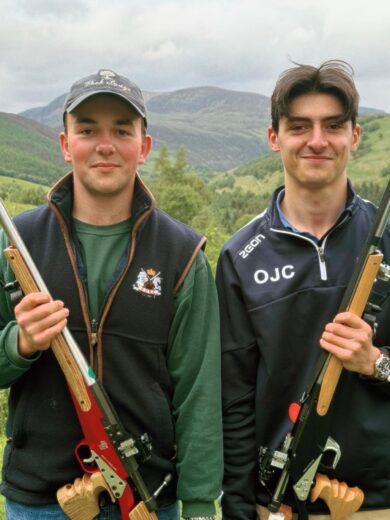
George Wood and Ollie Christy
Members of the Sedbergh School community are warmly invited to join us for Remembrance Sunday and the OS Club AGM.
Programme of Events:
7.30am – Bagpipes at the Cloisters
9.00am – Boer War Act of Remembrance at the Boer War Memorial
10.45am – Remembrance Service at the Cloisters, followed by coffee, tea and refreshments in Queen’s Hall
11.30am – Tea and coffee at the Hirst Centre
12.00pm – Buffet lunch at the Hirst Centre
1.00pm – AGM in the School Library
7.30pm – The Armed Man: A Mass for Peace – Concert in Powell Hall
If you would like to attend the lunch or the AGM please contact Maria Gallego-Calderon on sedberghassociation@sedberghschool.org.

The competition was started in 1955 by the Yorkshire branch of the OS Club and the trophy is an embroidered map of the local Sedbergh area. The winner has to embroider a badge onto the bottom of the map with his or her name, year and house.
The competition is a Stableford and is played at Ilkley GC where many OS are members.
Players will meet at lunch time and tee off from around 1.30pm and there is an informal dinner and prize presentation in the evening.
If you are interested in playing please contact Rob Downs on robdowns@hotmail.co.uk.
OS Sam Fisher (W 06–11) and Ben van Dijk (H 14–18) have helped rewrite mountaineering history as part of the seven-person Fellkour Squad which has broken a 33-year-old record for summiting all 282 Munros of Scotland in a relay challenge, while also raising money for charity. The Munros refer to Scotland’s highest mountains, each standing at least 3,000 feet above sea level. The fell-running team completed the challenge in an extraordinary 10 days, 18 hours and 16 minutes, beating the previous record of 11 days, 20 hours and 16 minutes by more than a full day. Across the relay, the team averaged a remarkable sub-one-hour pace per Munro of 54 minutes and 57 seconds. The attempt followed the same rules as the original 1993 record: with the baton carried on foot over the hills but transported by vehicle on public roads and by standard car ferries between mountain sections. Alongside Fisher and van Dijk, the Fellkour Squad included Harry “CoolDog” Cooling, Alistair “TDog” Thornton, Ferg Roberts, Jack Ravenscroft, and Ross Spaulding. Travelling the length and breadth of Scotland, they endured brutal terrain, heavy rain, snow and wind. In total, they covered approximately 1,505 km (approx.1,000 miles) and accumulated around 117,371 metres of ascent. The squad’s name, “Fellkour,” reflects their approach of combining fell running with a parkour-like style of moving through mountain terrain, using speed, agility and creative movement such as jumping and climbing. Through the challenge the team is proud to have raised funds for Pickups for Peace, a UK-based charity that delivers vehicles and vital aid to Ukraine. The scale of the achievement encompasses both the physical demands of completing all 282 Munros and the significance of breaking a record that had stood for more than three decades in Scottish fell running. Many congratulations to the Fellkour Squad. We’re excited to hear about what they’ll take on next! Click here for more information. Donate to Pickups for Peace via this JustGiving page.Once upon a time, it used to be simple. There was only red, white and rosé, but now we have orange, chilled red, natural, conventional and much more. It might appear that these new-fangled wines are a product of the hipster generation, but the fact is that they’ve been around much longer than you think. In fact, orange probably pre-dates white wine, and was previously just considered how white wine was produced. Have you ever noticed the wine in old paintings? If you look again, you’ll notice it isn’t translucent like modern wine but orange. Modern white wine is made by pressing the grapes, separating off the juice and discarding the skins, stems and pips. Orange wine is made by leaving the juice with some kind of skin contact, or even pips and stems, too. This can be for a couple of days, sometimes for much longer, like weeks, months and in extreme conditions, even years. In essence, what that means is that the wine takes in a whole lot of different flavours. Making it more robust, textured and complex depending on the grapes used, and the process. When we first started serving orange wine at the Black Bull, it took a while for people to get their heads around it. Whilst orange wine was becoming commonplace in the trendy bars of London and Manchester, we had seen it that much out in the sticks. It looked funny, it smelled funny, so people didn’t quite understand it, and it had some flavours we didn’t quite associate with wine, like bitter, marmalade and funky. It didn’t really help that I had a waiter at the time who insisted on telling customers it was made with actual oranges, something he found highly amusing, and I did not. Orange wine has now become much more common; you can pick it up on increasingly more menus. You can even find it now in supermarkets, but I’m not sure these would be ones I’d recommend. For me, it’s a go-to favourite. It’s so versatile with food, and many are simply very gluggable on their own. Taste-wise, orange wines can be the most unusual and can take a little bit of getting used to, but I would encourage you to try. Like all types of wine, and despite them still being rare, there is a large variety to choose from. The fresher styles of orange wine are probably the ones I’d recommend trying first. We have several on the menu, and we use them as an introduction to orange wine for those who haven’t tried it before. These usually have less skin contact and are much closer to white wine than others. They are very approachable, with flavours like tropical fruits, bruised apple, different types of tea and sometimes a little spice. These ‘fresher’ orange wines are often cloudy; some might have a slight fizz, but embrace this instead of letting it put you off. These can certainly be drunk alone or with lighter dishes like salads or roast chicken. Crazy Lud by Oskar Maurer is an excellent example, available online at Roland wines, or Entre Vinyes’s Oniric Brisat, available online from Modal Wines. Both are very approachable and very drinkable. Radikon is a winery in Friuli which shares a border with Slovenia. A relatively small estate that’s become synonymous with skin contact and orange wines. Hailed as one of the heroes of natural wine who helped pave the way for skin contact for white wines again in modern winemaking. Their Pinot Grigio ‘Sivi’ is one of the first orange wines I ever tried, or at least I remember. Pinot Grigio is often considered such a bland grape, the butt of many a wine joke, but it can produce some fantastic wine. The slightly pink tinge in the grape’s skin creates this crossover or blend of orange and rose, creating something very unique. It’s certainly a complex wine, with notes of candied fruits, tangerine, a bit of spice and elements of pith in taste and texture. This is just one of their wines, many of which can be bought in person or online at Buon Vino. If you visit the shop, I’m sure that if you pop into Courtyard Dairy, they’ll recommend a fantastic farmhouse cheese to go with it. For those looking for something a bit more serious, or even more mature and complex, there’s a selection which could be considered more sophisticated wines. Sometimes I panic when I see a crystal-clear orange wine; it can go one of two ways. The darker orange wines are generally so because they spend more time on the skins. In this process, they take on more tannins as well as bitter, less fruity and nutty flavours. Additional fermentation methods can lead to the wines being more oxidative, too. These are flavours that many wine drinkers don’t necessarily pair with a good wine. However, when the balance of these flavours is right, it can produce some excellent examples of orange wine. Ideally best with food, but these flavours allow the wine to stand up to some big flavours like cheeses, stews, curries, miso roasted foods and grilled oily fish. Klabjan, from Slovenia, do an excellent example of these more complex orange wines. It’s a wine I also try to have on the menu when it’s available. It’s made with Malvasia grapes, has notes of marmalade, apple compote and honeysuckle. Powerful and intense, with nuttiness and wild herbs. I’ve had several customers tell me they didn’t like orange wine until they tried this. This isn’t dipping your toe in, though; it’s full-on wild swimming on the fell top, but that doesn’t seem to faze people. Available online at Roland wines, which has a great selection of other orange wines too. The Black Bull Few Old Sedberghians can claim a journey as varied as that of Adam Rickitt (E 1991–96). From early ambitions on the rugby field to a brave leap into one of Britain’s biggest television institutions, his path has been shaped by hard work and a determination to be true to himself. In a wide-ranging interview, Adam reflected candidly on his time at Sedbergh, the lessons it instilled, and a remarkable career in the creative industries. It was a pleasure to visit Adam – and his dog – at Dexter & Jones, the colourful craft beer and artisan gin store he runs with his wife, Katy Fawcett, in the pretty town of Knutsford. For Adam, his standout memory of Sedbergh is the camaraderie. The environment, he believes, taught him some of the most important lessons of his life: respect, kindness and social versatility. “People often say to me, ‘What’s the point in boarding school?’ For me, it’s two things,” he says with crystal clarity. “The first is that you are thrust into this environment where you are forced to interact with people you wouldn’t normally interact with. So you learn respect, you learn how to get on with different people, you learn how to be kind to people.” The second lesson is work ethic: “It doesn’t matter whether or not you are the smartest kid in the class. You all just work hard because you know you’re lucky to be in that situation. Sedbergh instils in you a subconscious acceptance that everything you do has to be to the best of your ability.” Thirty years after leaving the School, the hills surrounding Sedbergh still loom large in Adam’s mind. “When you think about the visual geography, you only learn to appreciate it once you’ve left. At the time, it almost feels like you’re in a fortress because you’re surrounded by these fells. But then you look back and realise the amazing beauty you had there, looking out over all those valleys. It was just the most beautiful place in the world.” One of the most significant moments of Adam’s schooldays came during the Wilson Run. Having struggled with illness during his teenage years, completing the run became symbolic. “The first time I did the Wilson Run was when I started to get better,” he recalls. “Everyone knew I wanted to beat my dad’s time. It wasn’t especially fast, and I was nowhere near the top, but it was decent.” Adam’s eyes still light up as he recalls the support from the School community as he approached the finish line. “The absolute noise of people, even the rugby coaches were cheering. They knew what I’d gone through, and doing the run for me was the first test of proving that I could beat everything that was going on in my life.” The Rickitt connection to Sedbergh stretches back more than a century. His great-grandfather, grandfather and father all attended the school, as did Adam and his two brothers. “I did feel a lot of pressure because of my family’s historical presence there,” he says. “I remember on my second day, I was sitting in English and, sure enough, carved into the desk was ‘Rickitt woz ere 1901’ or something like that. That was my great-granddad!” He hoots with laughter at the memory. Like the generations before him, Adam initially saw rugby as his future. His goal throughout school was to earn a place on the 1st XV. But privately, he nursed another ambition. “I loved the camaraderie of rugby, but I also wanted to act, and I probably didn’t pursue it because I worried about what people thought.” That changed dramatically on the day he left school. Having secured a place at the University of Cambridge to study philosophy and law, Adam surprised everyone by announcing a completely different plan: he wanted to become an actor. “Dad was delighted,” says Adam with a dry smile. In reality, though, his father was remarkably supportive, telling him to take a gap year and give acting a proper try. If he could find work within a year, he could pursue it; if not, he would take up his place at Cambridge. What followed was so fortuitous it almost sounds implausible. This was before the internet era, so Adam headed to the local library and worked his way through a huge directory listing acting agents across the country. He found one in Manchester that ran drama classes and gave them a call. “I said, ‘Look, I’d like to become an actor. I’ve never done anything before.’ They told me there was a drama class starting the following week and said, ‘Come along, we’ll see how you get on.’” In the meantime, the agency suggested he attend an audition at Granada Television. “‘There’s no way you’ll get it,’ they said, ‘because you’ve never done any acting before. But it’ll show you what an audition is like.’” Adam arrived with no expectations. “I went along thinking it was basically a day off,” he says. “Then, two hours later, I got a phone call saying, ‘You’ve got the job on Coronation Street. You start Monday.’ So that was scary!” At the time, Coronation Street was a cultural phenomenon. In the 1990s, soaps dominated British television in a way that is difficult to imagine today, before streaming and the explosion of channels. “You were in people’s houses five days a week,” he says. “You became part of the family.” Adam admits he had little understanding of just how famous the programme was. “Soaps were a bit like football teams. My family watched EastEnders, so I’d never seen a single episode of Coronation Street and had no concept of how big it was.” The scale of the attention hit him the very night his first episode aired. Stopping at a supermarket with his mother after filming, he found himself mobbed by fans. “We should have been in and out in five minutes, but we were in there for four and a half hours because people kept coming in off the street to get autographs.” Working on the soap proved to be an extraordinary learning curve: a soap actor can’t be late or unprofessional, Adam explains, because the schedule runs like clockwork. He also credits seasoned actors on the show, including John Savident, with teaching him the craft of acting. “I was literally able to leech off him,” he says with a smile. “My drama school was basically in front of 20 million people, five days a week.” Adam’s fascination with acting began much earlier, inspired by his uncle, legendary stunt performer Bill Weston, whose credits included James Bond films, Alien, Star Wars, Titanic and the Harry Potter series. Watching his uncle appear on screen in The Living Daylights proved transformative. “It suddenly made me realise that the world you see on the screen is actually a created one – created by people,” he says. “From that point on, I always wanted to act.” Once he entered the profession, the hard-working Sedbergh mentality kicked in and remained central to his approach. “For me, the only way to justify fame or celebrity is to become good at your job. I wanted to become the best version of myself as an actor that I could be.” Having witnessed enormous change in the television industry, from a handful of channels to the age of streaming, he believes young actors now face a far tougher financial reality than previous generations. “There are far more creative opportunities now,” he says. “But the money’s falling out of the industry.” That reality led him and Katy to establish their own business, Dexter & Jones, allowing him to avoid taking acting jobs solely for financial reasons. “Even successful actors need something financially sustainable because careers go in peaks and troughs.” His advice to aspiring performers is wise and grounded: “Be passionate about being an actor, but don’t rely on it as the thing that puts food on your table or pays your mortgage. Have something else on the side as well.” Adam is equally candid about the darker side of celebrity, particularly during the height of tabloid culture in the late 1990s and early 2000s when newspapers could “ruin a career” overnight, often through fabricated stories. Social media, he believes, has at least given public figures the opportunity to tell their own story directly. But his own priorities remain far removed from celebrity culture. “I’ve never been to a celebrity party in my life,” he says. “Apart from the James Bond premiere, which was one of those moments where you think, ‘Sorry, I’m going to go to that!’” For Adam, the key is to pursue acting because you love the craft, not because you crave fame. “I’d far rather go for a run in the woods or a pub lunch with my wife than go to some showbiz party,” he says. “If you decide to chase fame, you’ll find it a very empty life.” Sedbergh continues to hold deep personal significance for Adam and his family. His father’s ashes have been scattered on Winder, overlooking the School, and his late mother’s ashes will soon be there too. “The Rickitt clan will always have a huge affinity to Sedbergh,” he says. “It’s been part of our family for over 100 years.” As the conversation draws to a close, Adam gives a warm and heartful message to current pupils: “Enjoy it. You have this amazing opportunity in the education you’re getting, and just open your eyes and look around. You are in one of the most beautiful parts of the country. The more you make of it, the better your life will be because of it… Don’t waste a second.” Article by Sedbergh AssociationAbbie Ward’s latest honour is well deserved. The Keswick-born rugby star has been named Cumbria Sports Personality of the Year at the Cumbria Sports Award 2026 after another remarkable season in which she helped England’s Red Roses lift the Rugby World Cup and continued to set standards at the very top of the game. For anyone who has followed Abbie’s career, the award is not just about trophies but also about the difference she makes on the pitch. She plays in the second row, but she brings many of the qualities you would expect from a top openside flanker: a huge work-rate, real strength at the breakdown, calm leadership under pressure, and the ability to change a game through determination. Opensides are expected to do everything: tackle, chase turnovers, carry hard, lead the defensive line and lift those around them. Abbie brings those same qualities in abundance from the second row. She never switches off, and her influence is felt in every phase. Her journey from Cumbria to the top of world rugby shows what is possible for athletes from rural areas. Starting with early coaching in Keswick and school rugby, Abbie has gone on to become one of England’s leading internationals while also playing a key role for Bristol Bears. What makes her story resonate locally is that she has never lost touch with where she came from. At the awards ceremony, she attended alongside her mother Libby and Alan Gray, one of her first rugby coaches, a nice acknowledgment of the people and places that helped shape her career. Cumbria has produced many talented sportspeople, but few match Abbie’s level of performance. She shows that top-level athletes can come from small communities and help inspire the next generation to aim high. Sportsperson of the Year is a fitting title, and for many young players watching from Cumbria’s touchlines Abbie Ward is a clear example of what courage and commitment look like.